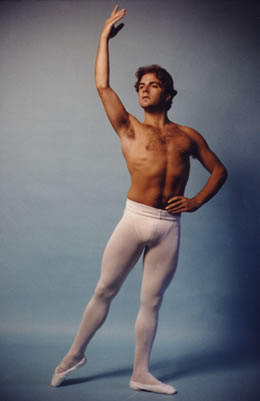
(Me at age 25)
At this point in my life I am a 25-year-old man who is very proud.
Why? What is the source of my pride? What actions have I taken to bring me
to this state of awareness? What method of thought have I used to guide these
actions? What character traits do I possess that enable me to utter such a
statement with complete certainty? How long will this pride last? Will it
remain automatically or will it require effort to sustain? These are the questions
I plan to address in this autobiographical essay.
Before going any further, it must be clear exactly what I mean by pride. Pride
is “the recognition of the fact that you are your own highest value and
… it has to be earned.”* This definition is to be distinguished
from such common misconceptions as “too high an opinion of oneself”
or “arrogant behavior.” A proud man does not boast of his achievements;
achievements to him are a way of life. He is not concerned with being better
than others; he is concerned with bettering himself.
So how does this apply to me? What have I done earn my pride? The first answer
that arises when I consider what I am proud of is: my independence. Particularly
for the past seven years I have been both financially and intellectually independent.
What does this mean? It means that I have lived exclusively by the use of
my own mind and effort, and have maintained an increasingly successful state
of life. It means that just as I have not lived off the material effort provided
by others, so I have not lived by the unproved assertions of others.
The major source of my pride comes from my ability to excel in a wide variety
of activities—science, business and art. In the realm of science I earned
outstanding grades in college while obtaining an Associate Degree in the science
of Electronics (simultaneously supporting myself by working full-time). Since
then, I have had four years of experience in the field. My knowledge covers
both computers and data communications. At present my employers have enough
confidence in me to leave me alone on the job to maintain the efficiency of
communications between New York and other major cities throughout the world
(a function usually performed by several people). In these past four years
I have also gained considerable knowledge and experience in the business field.
Although I am not yet ready to start my own business, I have had many of my
ideas implemented successfully with the companies I have worked for. Such
ideas have ranged from cutting costs on the production of goods to reorganizing
work habits for increased efficiency. These ideas are not only limited to
my previous employers. I am currently involved in cutting costs and organizing
business arrangements for a classical ballet production in which I will also
be performing. This brings me to the category of art.
For the past five years I have had a thorough training in classical ballet.
This training has led to two seasons of performances per year for the past
four years. My major attraction to the art of ballet is the fact that it is
a most eloquent expression of the concept of pride, reduced to the physical,
perceptual level. In other words, I can point to a classical dancer performing
in a heroic role and say: this is what I mean by pride. It is a controlled
discipline of one’s body. Additionally, ballet employs the proper relationship
between man’s body and mind: one of total harmony, i.e., with no clash
of values. Clearly this is not a mere physical activity but also one which
requires enormous intellectual effort. Fortunately I have studied at a ballet
school where the intellect is highly regarded. (Credit must be given to Madame
Gabriela Darvash for her rational approach to teaching this art.) Although
I have not gone as far as I would like in dance, I am proud of what I have
accomplished within the context of my other activities.
Thus far I have described my progress in the science and business of computers/electronics,
and in the art of dance. But there is one particular field of study, which,
since age 17, I have consciously used as the organizer and integrator of my
thoughts and actions. This is the science which is intended to fulfill the
role of guiding human action. More than anything else, this discipline has
brought me to where I am today. It is philosophy.
Philosophy is not merely an abstract science (thought it deals with the most
complex issues) but it is the most practical subject known to man. It gives
us a comprehensive view of reality and our relationship to it. As a result,
one of the proudest things I can say about myself is that I am a philosopher.
Not in the sense that I have originated a systematic set of ideas, but in
the sense that I understand, accept and live by a systematic set of ideas.
In other words, I practice what I preach. And what do I preach? In three words:
reason, selfishness and individualism. Reason is the faculty of perceiving
and integrating sensory evidence. This is what distinguishes us from every
other species. It is our essential means of survival, our only means of gaining
knowledge and only proper guide to action. Selfishness is the principle
that I do not sacrifice myself to others nor others to myself. This ethical
premise holds that nothing is more important on earth than my life; that I
live by my rational judgment, for my own happiness. Individualism is
the principle that I should be free to do so and so should everyone else;
that I respect everyone’s right to pursue their own values and everyone
respects mine. It is selfishness applied to a social context.
I have studied philosophy for the past eight years. I have written papers
and given speeches on the subject. I am constantly attending lectures, holding
courses recorded on tape, and discussing its theory, application and history.
This should serve as an explanation of the crucial role philosophy has played
in my life.
This concludes, in essence, the most fundamental reasons for my opening statement.
At this point it might be asked what type of influences I have had in my life.
There have been many non-essential influences. Two immediate one that come
to mind are that I am an American and I am a New Yorker. Although I had no
choice about being born here (that is why it is non-essential) these two have
certainly been helpful. As an American, I am freer in this country to pursue
my values than I would be anywhere else. As to New York, living here for my
entire life has given me ample opportunity to identify extreme examples of
wealth and poverty, achievement and failure, effort and laziness, thinking
and evasion. My evaluation of this evidence has weighed heavily in the choice
to remain here. But even if I did not grown up here I do not believe my character
would have been radically different.
Essentially there has only been one influence in my life: Ayn Rand. This philosopher-novelist
transformed me from a 17-year-old boy with mixed premises into a man of reason.
Ayn Rand taught me how to think. More importantly, she taught me to act on
my thoughts. Her magnum opus, Atlas Shrugged, has served as an inspiration,
a dictionary and a moral guide throughout my entire adult life. Ayn Rand has
explained with precision and detail the ideas which I had always accepted
but merely felt as a teenager. She has shown the crucial relationship between
the values of body and spirit. In the history of philosophy this is unprecedented.
Although I have always been proud of my intellectual and physical abilities,
it is Ayn Rand who taught me to take pride in being proud. I refuse to kneel
down for anyone—I will always stand up for her. Usually I stand alone.
But it is worth it. If this sounds like blind hero-worship, I assure you it
is not blind. Do I agree with everything she has ever said? Certainly not.
Ayn Rand enjoyed cigarettes and disliked Beethoven’s music. I dislike
the former and enjoy the latter. But these are not basic issues in philosophy.
What I do agree with her are the fundamental, i.e., reason, selfishness and
individualism. It is according to the principles of her philosophy of Objectivism
that I live my life. It is to her name and honor that my every achievement
is dedicated.
Is there anything I regret in my life? Yes. The fact that I know of relatively
few people who share this view of life and practice it consistently. Particularly
women. (I mention this last not as an attack on women, but as an expression
of my longing for a worthy romantic partner.) To those who do meet these requirements,
I offer my profound gratitude.
What about the future? What does it entail? Right now I am preparing for a
transition, not in my method or values, but in the focus of my activities.
These will be directed more toward getting my business career started (since
I am a capitalist philosophically, it is now time to become one financially).
As a result, less time will be given to dance and formal activities in philosophy.
I am often asked where I get the time and energy to do everything I do. I
believe that one uses one’s time according to one’s priorities.
That is, if a serious values it to be gained, one will reserve the time necessary
for acting to gain and/or keep that value. Being a selfish, long-range thinking
man, my priorities are usually clearly defined and carried out in order to
bring about maximum results. In other words, I do not waste much time. This
corresponds to the fact that one of the cardinal virtues of the Objectivist
philosophy is productiveness. Psychologically, the explanation for my enormous
energy and drive is my love for this world. I plan to achieve as much as possible
in my life because I will not get another chance—here or anywhere else.
I do not take my life on earth for granted in any manner, particularly by
expecting to be rewarded only after I die.
However, my purpose for writing this essay is not to speak about death but
about life. My life. The culmination of the philosophy of Objectivism is man’s
happiness, i.e., a state of joy without contradiction. I know that I have
reached this state. But happiness will not remain automatically. One must
choose to take the proper actions in each situation of one’s life in
order to remain happy. (For details read the works of Ayn Rand.)
One important way of expressing happiness is to give oneself credit for an
effort performed to the best of one’s ability in any rational endeavor.
This is the virtue of pride. This is what I am fighting to preserve in the
midst of a world collapsing from self-sacrifice and humility. Sometimes it
is a very lonely battle. One day I will look back at these pages, perhaps
for inspiration, and remind myself that it is … “the battle for
any achievement, any value, any grandeur, any goodness, any joy that has ever
existed on this earth.”*
* Atlas Shrugged